April 23, 2026
If you’ve been in the water around Catalina recently, you may have noticed—it’s warmer than usual. Our data confirm it.
At the CIMI Spotter Wave and Temperature Buoy, which measures temperature at about 1 meter (near the surface) and 10 meters depth, we’ve been tracking this closely. Temperatures have been above normal since May 2025, but they have intensified sharply over the past month.
Since March, temperatures have frequently reached the mid-60s°F, with peaks approaching 69°F near the surface (we see temperatures like this in July!). Typically, we expect winter temperatures to be in the fifties and even low fifties during cooler years. We’re also seeing more rapid swings in temperature, suggesting the ocean is less stable than usual, a sign that normal seasonal cooling processes may be weaker this year.

Graph of water temperature from January 1 - April 23, 2026 at CIMI Toyon Bay. Blue line represents the temperature at 1 meter, the red line represents the temperature at 10 m.
What Does “Above Normal” Mean?
Scientists often describe ocean conditions using temperature anomalies:
A temperature anomaly is the difference between what we measure and what’s typical for that time of year.
Red (positive anomaly) = warmer than normal
Blue (negative anomaly) = cooler than normal
Data from the San Pedro Buoy below show that 2026 has been dominated by positive anomalies, meaning the ocean has been consistently warmer than expected—sometimes by more than 5 degrees.
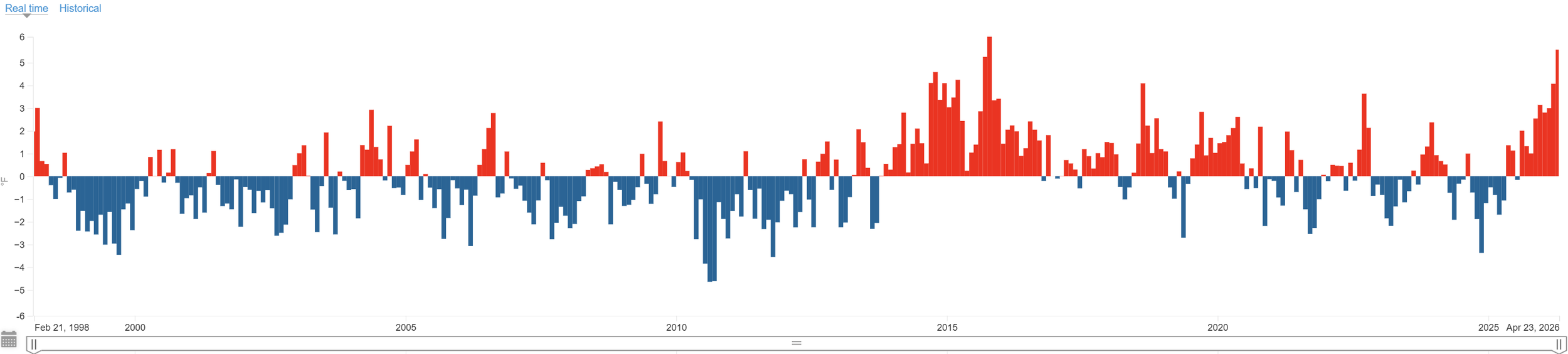
Temperature anomaly from the CDIP San Pedro Buoy 092 from 1998 to April 2026.
Is El Niño Coming?
You may be hearing that an El Niño could develop later this year—and it’s related, but not exactly the same thing.
El Niño is a natural climate pattern that happens every few years when warm water spreads across the central and eastern Pacific Ocean.
Normally:
Winds push warm water westward (toward Asia)
Cold, nutrient-rich water rises along California (good for kelp)
During El Niño:
Those winds weaken
Warm water shifts east and eventually up toward California
Upwelling is reduced
This leads to:
Warmer coastal waters
Fewer nutrients
Often, more storms in Southern California during winter
Right now, we are not in an El Niño yet, but conditions in the Pacific are trending in that direction. If El Niño develops later in 2026, it could reinforce the warm conditions we’re already seeing.
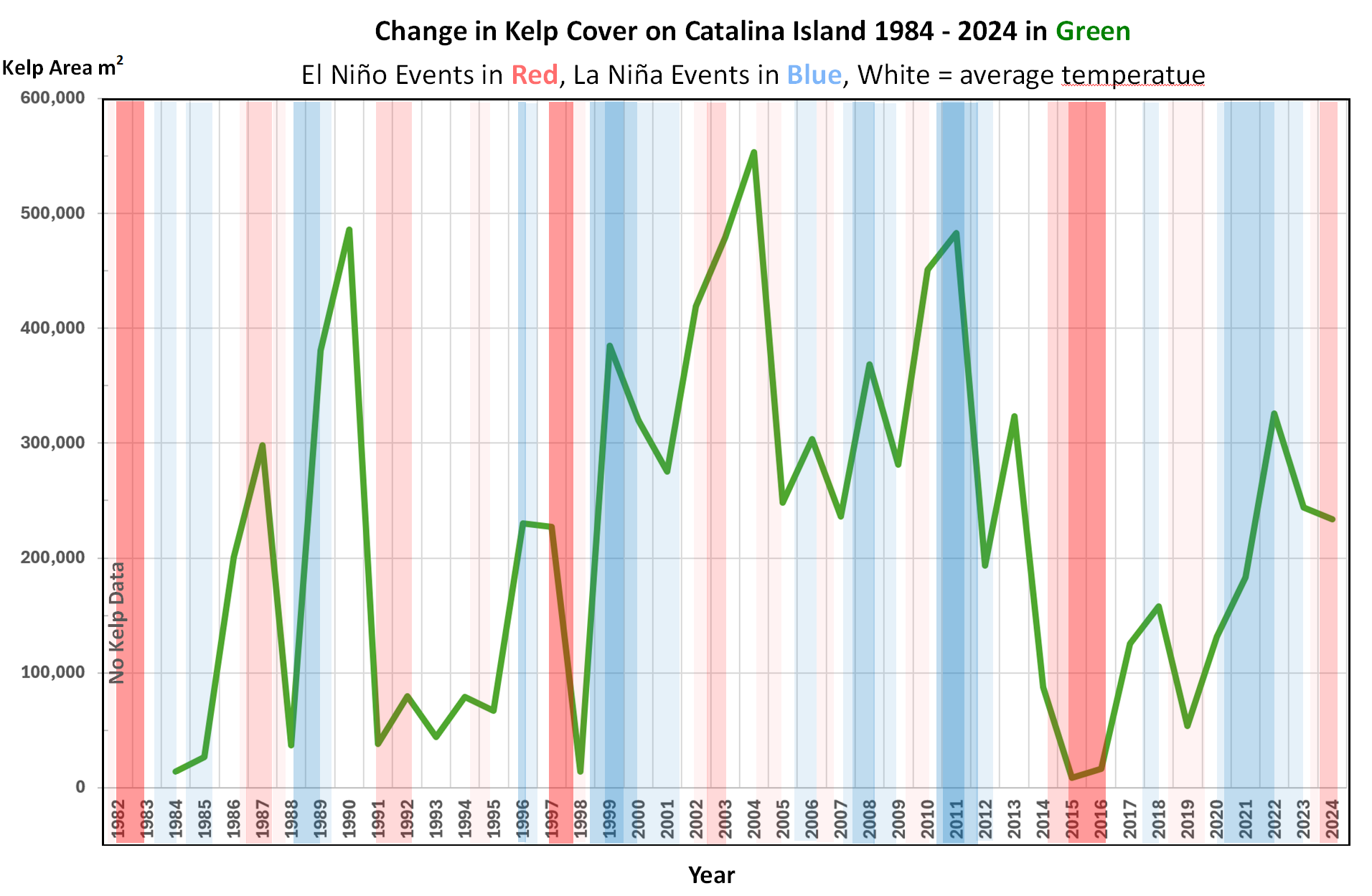
Patterns of El Niño and La Niña from 1982 through 2024. The green line represents the change in kelp canopy over that time on Catalina Island.
Why This Matters for Kelp Forests
Kelp forests depend on cold, nutrient-rich water, especially in spring when they grow the fastest.
A recent report from Scripps Institution of Oceanography in San Diego highlights that weakened upwelling and persistent high pressure have allowed warm water to build along the coast this year.
When warm conditions persist:
Kelp growth will slow and recruitment of new kelp will decrease or even stop
Turf algae and invasive species like Sargassum horneri can expand
Fish and invertebrate communities may shift and tropical species like triggerfish, pufferfish or even poisonous sea snakes can appear!
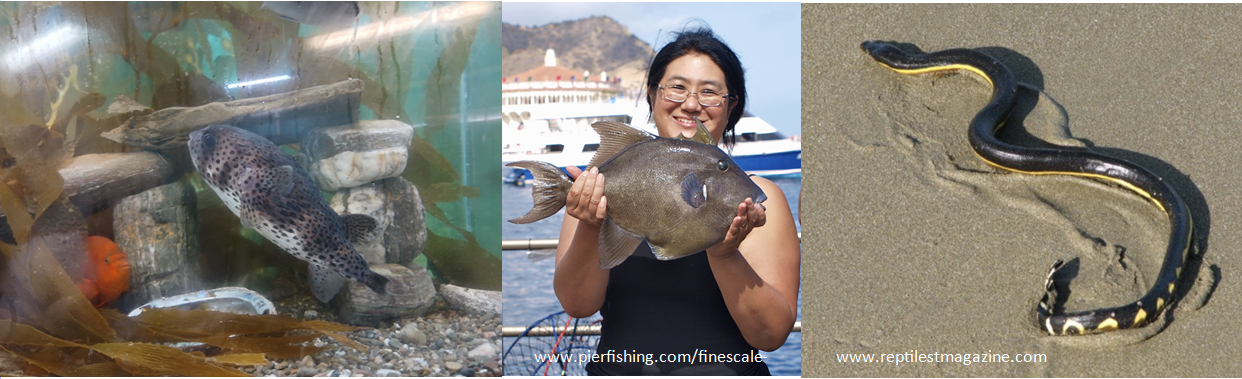
1) A Spotted Porcupine Fish (type of pufferfish) caught at CIMI Fox Landing, 2) A Fine Scale Triggerfish caught off of the Avalon Pier (2016), 3) A poisonous Yellow-Bellied Sea Snake found on the beach in Ventura (2016).
What Happens Next?
Spring is usually when the ocean cools as upwelling strengthens. If that happens soon, conditions could improve.
But if warm water continues—and especially if El Niño develops—we could see a longer-lasting marine heatwave into summer and beyond.
At CIMI, we’re continuing to monitor these changes closely. What we’re seeing now is more than just warm water—it’s part of a larger ocean pattern that could shape Catalina’s kelp forests in the months ahead.