Spotting Sea Turtles Around Catalina: How to Help Identify Our Local Visitors
Guest Blog written by Jenna Contuchio, Sea Turtle Researcher UCSC
If you’ve been lucky enough to spot a sea turtle around Catalina Island in recent years, you’re not alone! Reports of turtle sightings around the island have increased steadily over the past decade. As ocean temperatures warm and species expand their ranges northward, more green sea turtles are foraging and resting in Catalina’s nearshore waters. There have also been reports of olive ridley sea turtles, and loggerhead sea turtles as well! Please see the Turtle species ID guide for more reference on who's who among sea turtles in the California Current.
I’m working with the Catalina Island Marine Institute (CIMI) and partners across Southern California to document and identify these individual turtles through photos and videos submitted by community observers. Each image helps us understand which turtles are visiting, how often they return, and how they use Catalina’s coastal habitats. This is essential information for conservation and management as the ocean continues to change.
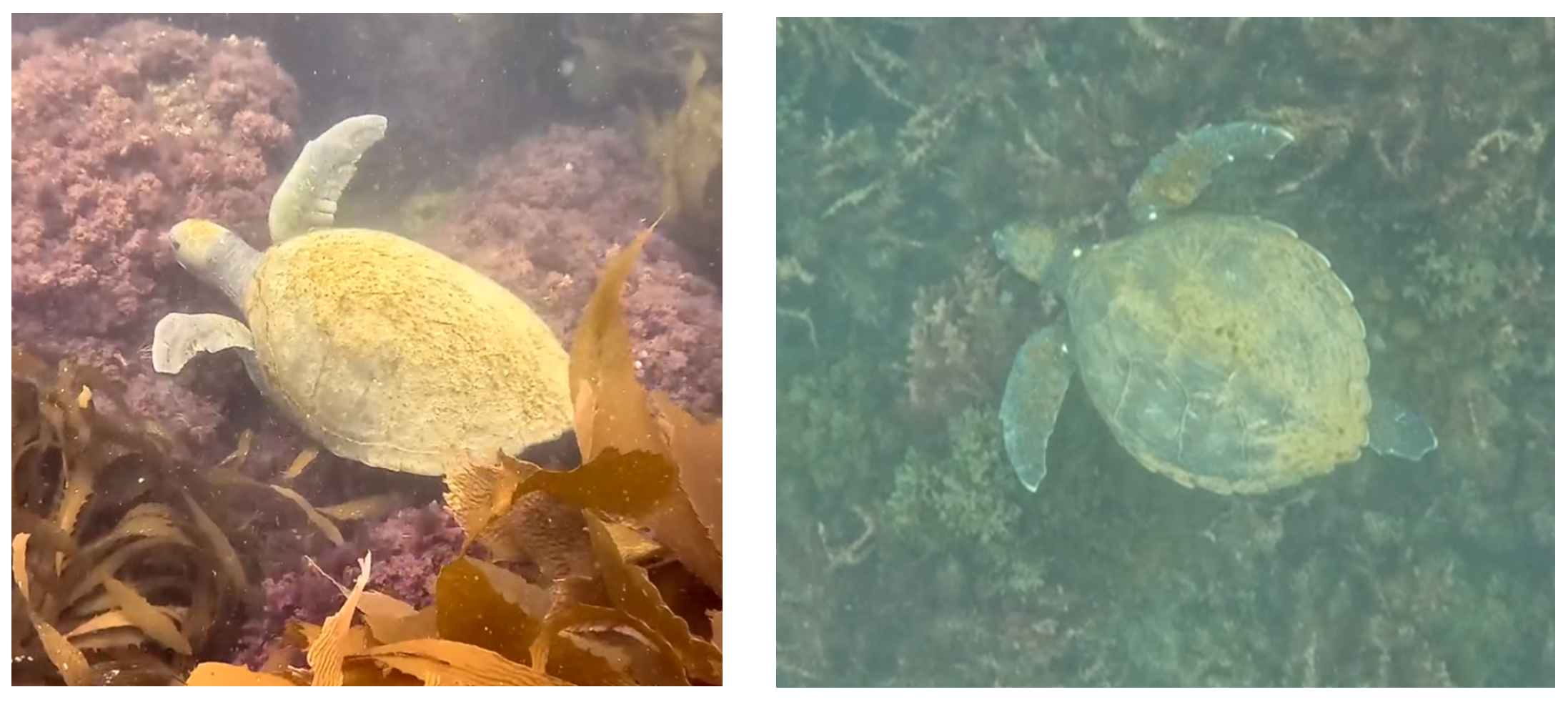
Green turtles seen near CIMI, Toyon Bay. Left Photo: A larger green turtle is feeding on Plocamium, a red algae, in 8 feet of water. Right Photo: A smaller green turtle, nicknamed Tripod, that is missing his left rear flipper. Photos taken from video by Sally Bartel.
How We Identify Individual Turtles
Every sea turtle has a unique pattern of scales (called scutes) on its head, flippers, and shell which are a natural “fingerprint.” Using a computer-vision tool called SIFT (Scale-Invariant Feature Transform), I analyze these scute patterns, shell shapes, and other distinguishing features such as scars or missing flippers to match new photos against a growing catalog of known individuals.
So far, we’ve identified nine unique turtles around Catalina with about 75 % identification accuracy, validated using multiple images of two known individuals. Some turtles, like “Tripod,” who’s missing a left hind flipper, are easy to recognize, while others require high-resolution images from several angles. Each new match helps refine our model and improve accuracy across the population!
How You Can Help
You can contribute to this research by sharing your photos and videos of sea turtles around Catalina! Here are a few quick tips to make your sightings scientifically valuable:
Keep your distance - observe respectfully from a distance to avoid disturbing the turtle.
Capture the details – try to photograph or video the head (especially the cheek area), both front flippers, and the full top of the shell.
Multiple angles are best - if possible, take a short video as the turtle surfaces or swims by; this helps identify unique scute patterns.
Note the date and location - even approximate coordinates or a general area (e.g., “near Toyon Bay”) are helpful for mapping movements.
Take note of habitat and behavior - this is incredibly helpful to see how the turtles are spending their time in Catalina!
Why It Matters
Each sighting contributes to a growing dataset that reveals patterns of movement, habitat use, and site fidelity to discover whether the same turtles are residents, or return seasonally year after year, and how they move along the coast. This kind of long-term, community-powered monitoring is especially important as the California Current continues to warm and new foraging habitats emerge.
Together, we can build a clearer picture of how sea turtles are adapting to our changing ocean and ensure Catalina remains a safe and thriving part of their expanding range.
If you’d like to share your photos or learn more, please email me at jecontuc@ucsc.edu